Why Does My Water Still Feel Hard? A Troubleshooting Guide for Eau Claire WI Homeowners
If your water still leaves spots, feels different after bathing, or creates mineral buildup despite having a water softener, several issues could be responsible. Learn what to check and when to seek professional help.
Why Water May Still Seem Hard After Softening
Installing a water softener should reduce calcium and magnesium, the minerals responsible for water hardness. However, some homeowners continue to notice spots on fixtures, soap that is difficult to rinse, or residue on shower doors even after installing a system.
These symptoms do not always mean your water softener has failed. Soap residue, cleaning product buildup, plumbing conditions, and other minerals can create similar problems. Before replacing equipment or changing its settings, it helps to identify what is actually happening.
For Eau Claire homeowners, testing the water is a useful first step. The City of Eau Claire draws municipal water from groundwater wells and treats it before distribution. Its water quality report provides information about the public supply, but the hardness level at an individual property can still depend on the water source and plumbing conditions. Homes using private wells should arrange appropriate testing rather than assume their water matches the municipal supply.
Check the Salt Level in Your Brine Tank
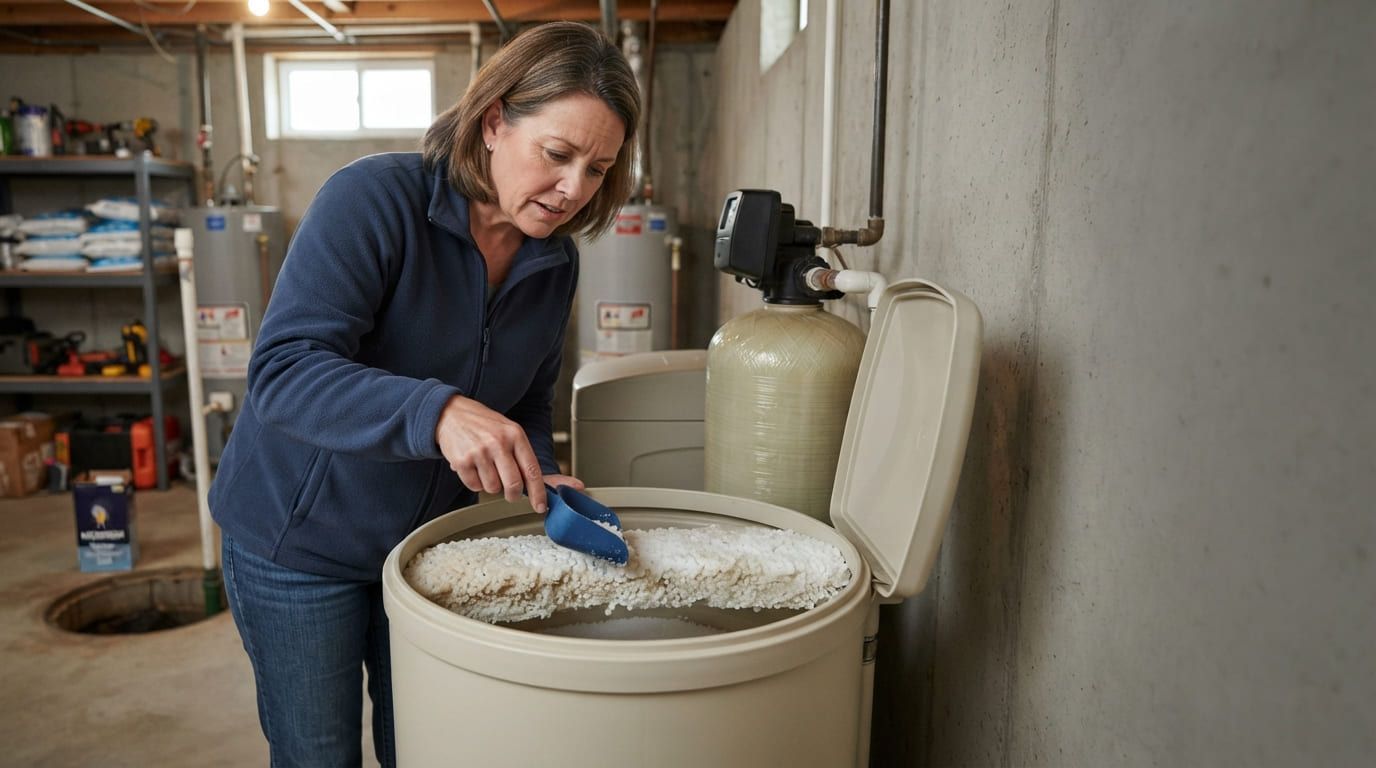
If your system uses salt for regeneration, start by checking the brine tank. The salt helps restore the resin beads that capture hardness minerals during normal operation.
When the salt level becomes too low, the system may not regenerate effectively. Over time, the resin can become loaded with calcium and magnesium, allowing more hardness minerals to pass into your household water.
Look inside the tank and confirm that there is enough salt for your system. Follow the manufacturer's recommended fill level instead of automatically filling the tank to the top.
Also check for a salt bridge. This is a hardened crust that forms above an empty space inside the tank, making the salt appear sufficient when the water below cannot dissolve it properly. If you suspect a bridge, follow the manufacturer's instructions for safe removal and avoid damaging the tank or internal components.
Make Sure the Bypass Valve Is in the Correct Position
Many water softeners have a bypass valve that allows water to flow around the treatment system. This can be useful during maintenance or repairs, but it also means untreated water may enter your plumbing if the valve is left in bypass mode.
Check the valve position and compare it with the instructions for your equipment. If it is set to bypass, the softener may not be treating the water at all.
Do not force a stiff valve or adjust unfamiliar plumbing connections. If the valve position is unclear or the system appears to be leaking, contact a qualified technician to inspect it.
Review the Regeneration Schedule
A water softener periodically regenerates its resin so it can continue removing hardness minerals. Depending on the system, regeneration may occur on a timer, according to measured water use, or through another programmed control.
If regeneration does not happen when needed, the resin can lose its ability to soften water effectively. Incorrect clock settings after a power interruption, unsuitable programming, or a malfunctioning control valve may contribute to the problem.
Check that the displayed time is correct and review the regeneration settings using the manufacturer's manual. Avoid changing several settings at once, since incorrect programming can waste salt and water or reduce performance.
If the system repeatedly fails to regenerate or displays an error, professional diagnosis may be needed.
Could the Resin Be Worn Out?
Inside a conventional water softener, small resin beads attract calcium and magnesium ions. Over time, these beads can become less effective because of age, physical deterioration, or contamination.
Iron is one possible concern. Certain forms of iron can accumulate on the resin and interfere with its ability to remove hardness minerals. Sediment and other water quality issues may also affect system performance.
If your water has a metallic taste, unusual discoloration, or orange or brown staining, do not assume that a larger dose of softener salt will solve the problem. Have the water tested for hardness and iron, along with any other concerns suggested by the symptoms. Depending on the results, a separate filtration system or resin service may be appropriate.
Understand the Difference Between Hardness and Residue
Not every spot or film is proof that hard water is passing through your softener.
For example, soap can leave a film on shower walls, while detergent and rinse aid choices can affect the appearance of dishes and glassware. Certain minerals and other dissolved substances may also leave residue that a conventional softener is not designed to remove.
A hardness test provides a more dependable answer than judging water by how it feels. Testing untreated water and softened water separately can help establish whether the system is reducing hardness as expected.
If the treated water has low hardness but residue remains, the next step may be to investigate cleaning products, appliance settings, or other water quality factors instead of replacing the softener.
When Should You Call a Water Treatment Professional?
Basic checks can identify common problems, but some issues require an experienced technician. Consider scheduling an inspection if the system has adequate salt yet the treated water remains hard, regeneration does not complete, the control valve malfunctions, or you notice persistent staining and unusual water quality changes.
A professional can test the water, inspect the resin and control components, review system sizing, and determine whether repair or replacement makes sense.
For Eau Claire properties supplied by private wells, periodic water testing is especially important because groundwater conditions can vary between locations. Even municipal water customers should use a test at the tap when diagnosing a specific household problem.
Get Help With Water Softener Problems in Eau Claire WI
A water softener that seems ineffective does not necessarily need to be replaced. Low salt, a bypass valve, incorrect regeneration settings, worn resin, or a different source of residue may explain the symptoms. Testing the water and checking the system methodically can help prevent unnecessary repairs and equipment purchases.
Eau Claire Water Softener can help homeowners in Eau Claire, WI explore water softening options, identify possible maintenance needs, and understand which treatment solutions may suit their household. Contact Eau Claire Water Softener to discuss persistent hard water symptoms and the next steps toward reliable water treatment.